




When ChatGPT names three businesses and skips a fourth, it can feel arbitrary. It isn’t random, but it also isn’t a public ranking list you can look up.
This article walks through what we can reasonably say about how those recommendations form, what remains unknown, and how to put your brand in a stronger position. It’s a core question in AI SEO, so we’ll keep it honest and practical.
Does ChatGPT keep a list of “approved” businesses?
No. There’s no directory to sign up for and no registry to be added to. ChatGPT generates answers based on patterns in the information it has learned from, and, when it searches the web, on pages it retrieves at that moment.
So the useful question isn’t “how do I get listed?” It’s “how do I become the kind of business the information consistently points to?”
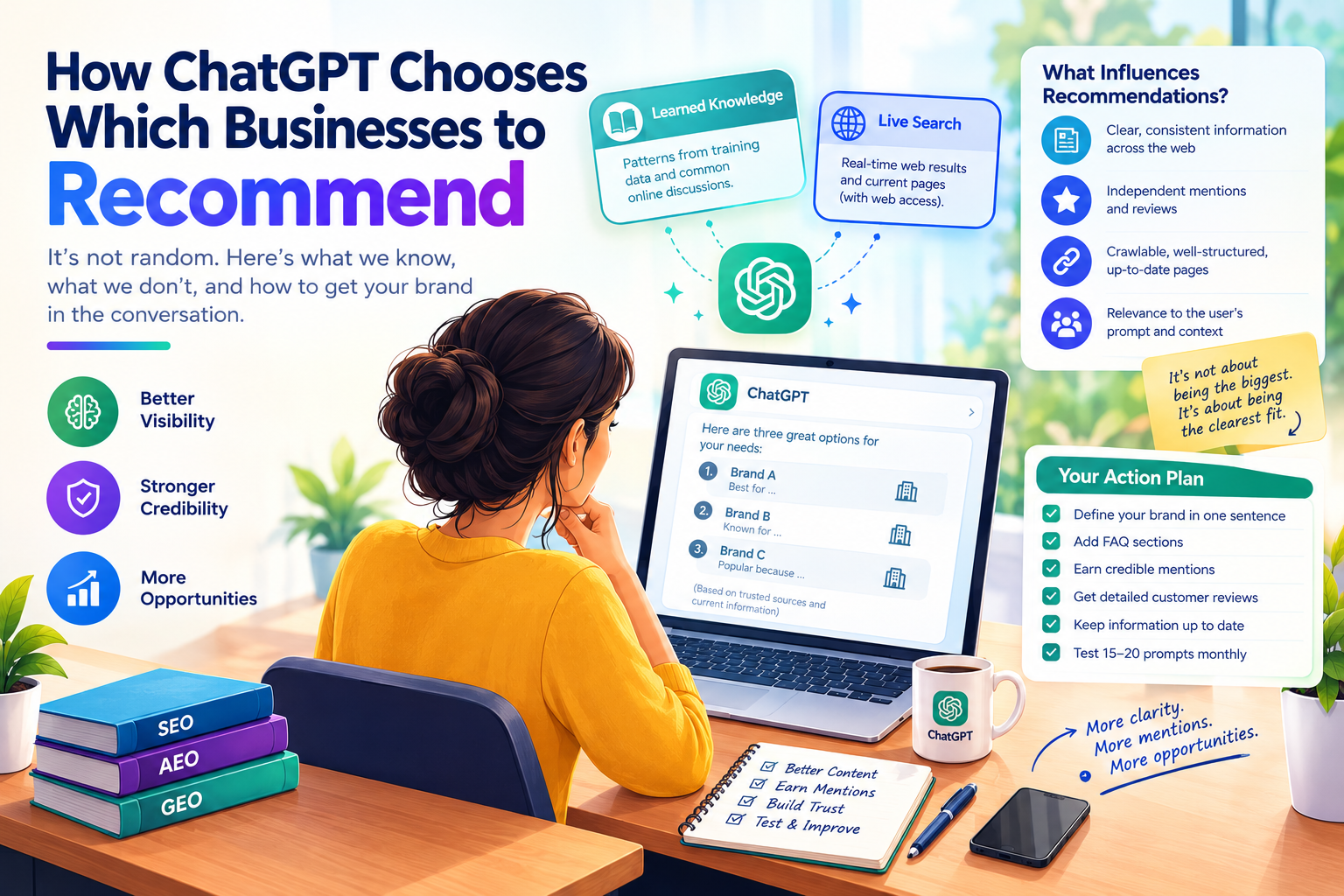
What are the two ways ChatGPT forms an answer?
In broad terms:
- From learned knowledge. The model draws on what it absorbed in training. Brands discussed often, clearly and credibly across the web are easier for it to recall.
- From live search. When web access is used, it pulls current pages and summarizes them. Here, crawlable, well-structured, current pages have an advantage.
A strong AI SEO plan serves both: long-term reputation for the first, clean and quotable pages for the second.
Why does the same question give different answers?
Because answers depend on wording, context and sometimes the mode being used. “Best CRM” and “best CRM for a five-person agency in India” can produce different brands. Even identical prompts can vary between runs.
This is why one screenshot proves little. Patterns across many prompts and dates are what count.
Why does ChatGPT recommend my competitor instead of me?
Usually one or more of these:
- They’re described more clearly. Their niche, audience and offer are easy to summarize in a sentence.
- They have more independent corroboration. More reviews, articles and discussions say similar things about them.
- Their information is more consistent. Names, services and details match across sources.
- Their content answers the question directly. Yours may bury the answer in marketing language.
None of these is about size alone. Smaller brands with sharper positioning often get named ahead of bigger, vaguer ones.
What kinds of sources seem to carry weight?
We can’t see the exact weighting, but credible, independent sources tend to matter more than self-published claims: reputable publications, established review platforms, professional directories, expert commentary and genuine community discussion.
Your own website still matters, because it’s the reference point that everything else should agree with. But it works best as the anchor, not the only voice.
How does the user’s prompt change the recommendation?
A lot. Specifics like location, budget, company size, industry and use case steer the answer. That’s good news for focused businesses: you don’t need to be the best overall, just the clearest fit for a defined group.
This is why Sarkar SEO often advises clients to sharpen their positioning before chasing more mentions. “AI SEO for SaaS startups” is far easier for a model to place than “digital marketing solutions.”
What can’t anyone control?
Be skeptical of anyone claiming total control. Nobody can dictate model behavior, guarantee a placement, or predict exactly how an answer will read next month. Models update, sources change and competitors improve.
What you can control is the evidence: how clear, consistent and credible your brand looks across the web.
What practical steps improve my chances?
- Write a one-sentence description of who you serve and what you do, and use it everywhere.
- Add FAQ sections with short, direct answers to your core pages.
- Earn mentions in credible, relevant publications.
- Encourage detailed, specific customer reviews.
- Keep pricing, service pages and key facts up to date.
- Test 15 to 20 realistic prompts every month and log the results.
Sarkar SEO follows this same loop with clients: define, structure, earn mentions, test, repeat.
Can I pay to be recommended?
Organic recommendations aren’t something you can simply buy. You can, however, invest in the work that earns them: better content, real PR, genuine reviews and a clearer brand. Be careful with any provider who sells “guaranteed ChatGPT placement.”
The bottom line
ChatGPT’s recommendations reflect the evidence it can find and understand. Make your business easy to describe, easy to verify and easy to quote, and you move the odds in your favor.
If you want to see how your brand currently appears, Sarkar SEO can run a prompt-based visibility review and show you where to focus first.
