




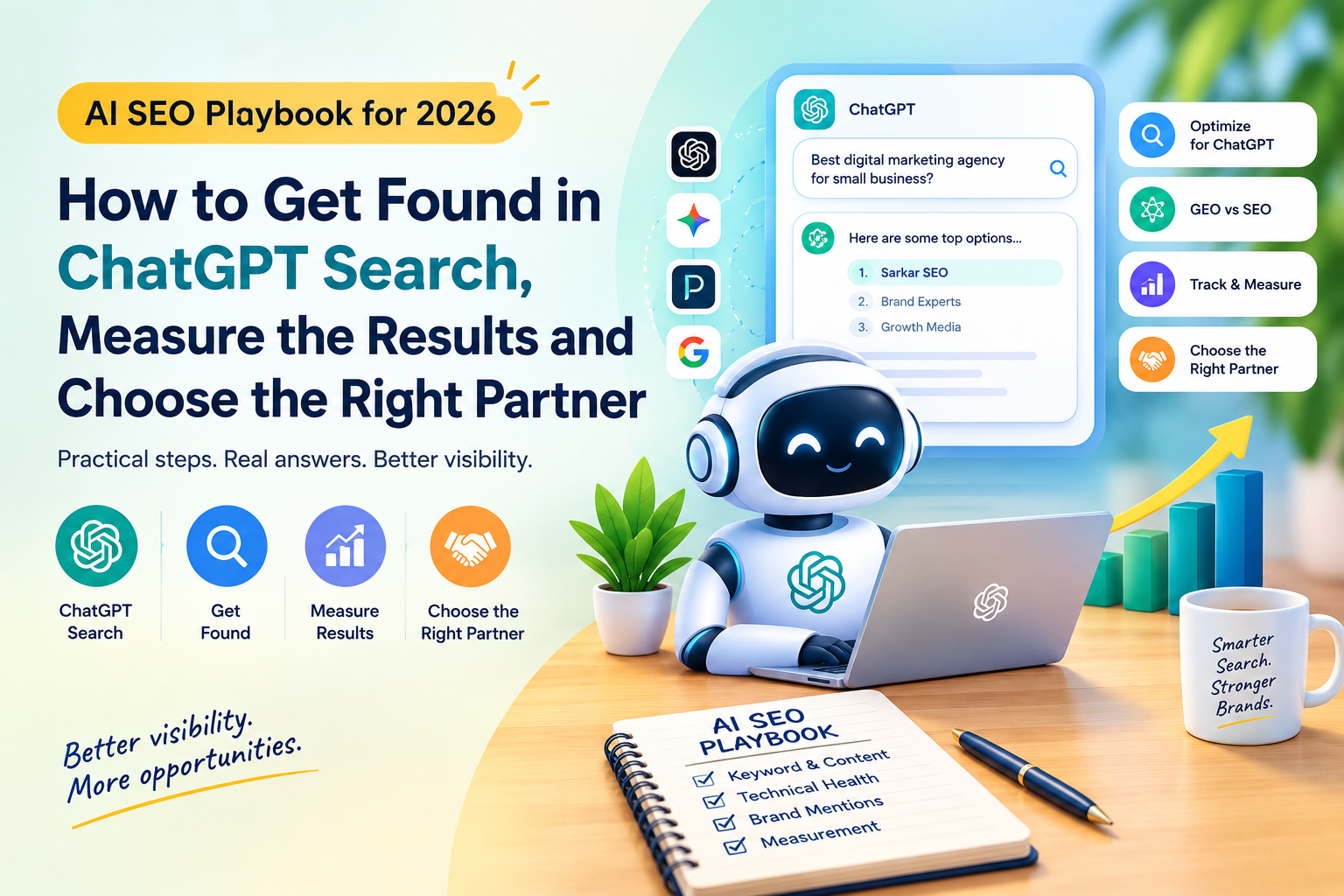
More people now start their research inside an AI chat window instead of a search bar. They ask for a recommendation, get a short list and often act on it without visiting ten websites first. If your brand isn’t part of that list, you lose attention you never knew you had.
This guide skips the theory and answers the practical questions we hear most about AI SEO.
How do I optimize my website for ChatGPT search?
Start by remembering that ChatGPT search pulls from live web pages, so your site has to be easy to read, easy to trust and easy to quote. Five things make the biggest difference:
- Let AI crawlers in. Check your robots.txt file and security settings. Many sites block AI bots by accident, which makes them invisible.
- Write answer-first content. Put the direct answer in the first two sentences under each heading, then add the detail.
- Be specific. Replace phrases like “we offer quality solutions” with what you do, for whom, where and at what level.
- Add structured data. Organization, FAQ, Article and Service schema help machines understand your pages without guessing.
- Keep pages fresh. Update key pages regularly and show the date. AI tools lean toward current information.
None of this is complicated, but most websites still skip at least three of these steps.
Is GEO different from what an SEO agency already does?
Partly. A traditional SEO agency focuses on rankings, traffic and links. Generative Engine Optimization (GEO) focuses on whether AI models mention your brand and describe it accurately.
That means GEO work goes beyond your own website. It includes your presence in reviews, industry publications, forums, directories and expert roundups, because AI models learn from all of these sources. Sarkar SEO approaches this as a full-picture job: fix the site, strengthen the brand’s footprint around the web, then measure what the AI actually says.
How do I choose a good GEO or AI SEO agency?
The market is crowded with agencies that added “AI” to their service list overnight. Before you sign anything, ask these questions:
- Can you show real examples? Look for screenshots of actual AI answers, not just ranking charts.
- How do you measure success? A good answer includes prompt-based tracking, citation counts and brand mention rates.
- What will you actually do? Vague promises are a warning sign. You should hear specifics about content, entity cleanup and off-site mentions.
- Do you guarantee results? Be careful. No one controls what ChatGPT says. Honest agencies promise a process and measurement, not magic.
- Do you still cover SEO basics? AI visibility sits on top of technical and content foundations.
If an agency can’t explain its method in plain language, keep looking.
How do I measure AI visibility before and after optimization?
You can’t improve what you don’t measure, and this is where most businesses stumble. Here is a simple before-and-after framework:
Step 1: Build a prompt list. Write 25 to 40 questions your ideal customer would ask, mixing broad (“best accounting software for freelancers”) and specific (“accounting software with GST invoicing”).
Step 2: Record a baseline. Run every prompt across ChatGPT, Gemini and Perplexity. Note whether your brand appears, in what position, and how it is described.
Step 3: Track three numbers. Mention rate (how often you appear), citation rate (how often your site is linked) and sentiment (how you are described).
Step 4: Optimize for 60 to 90 days. Improve your content, fix entity details and build credible mentions.
Step 5: Re-run the same prompts. Compare results against the baseline.
One caution: AI answers vary from run to run, so test each prompt several times and look at trends instead of single results.
What should a realistic benchmark look like?
Be wary of anyone who gives you one universal number. Visibility depends heavily on your industry, your competitors and how well-known your brand already is. A local service business, a SaaS startup and a global retailer start from very different places.
Instead of chasing an industry average, benchmark yourself against three or four direct competitors on the same set of prompts. Your goal is simple: appear more often, be described more accurately and get cited more frequently than you did last quarter.
What mistakes should I avoid?
- Writing for machines only. Content that reads like a robot wrote it rarely earns trust from AI or people.
- Ignoring your brand details. Conflicting names, addresses or service descriptions confuse AI systems.
- Expecting overnight results. Visibility builds over weeks and months, not days.
- Abandoning traditional SEO. AI tools still draw on the pages that strong SEO helps you build.
