




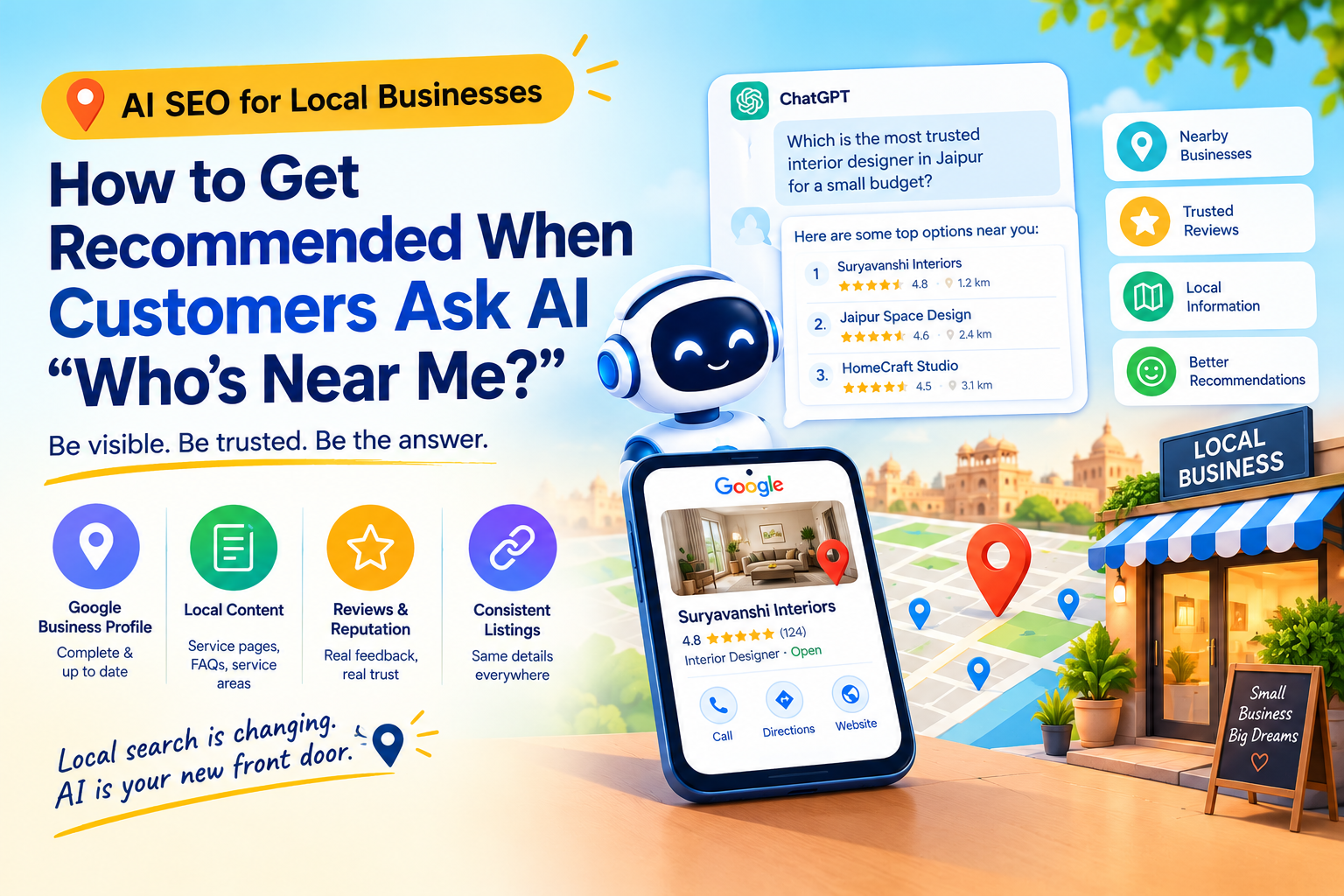
Not long ago, finding a local plumber, clinic or coaching centre meant typing a few words into Google and scrolling through a map. Now people ask AI directly: “Which is the most trusted interior designer in Jaipur for a small budget?” and the AI answers with a short list.
For small businesses, this is both a threat and an opportunity. A big brand no longer wins just because it has a bigger ad budget. A clear, well-documented local business can earn a spot in the answer. Here’s how AI SEO works at the local level.
Does AI SEO matter if I only serve one city?
Yes, and arguably more than for national brands. Local queries are high-intent. Someone asking AI for a nearby service is usually ready to call, visit or book. If your business isn’t mentioned, that customer goes to whoever is.
AI SEO for local businesses simply means making sure AI tools can confidently answer three things about you: what you do, where you do it and why people trust you.
How do AI tools decide which local business to suggest?
They look for agreement. When your Google Business Profile, website, directory listings, reviews and social pages all describe the same business with the same details, the AI treats you as a reliable entity. When details clash, such as two phone numbers, an old address or a vague service list, confidence drops.
Local visibility also leans on proximity, relevance and reputation. You can’t change where your shop is, but you can control how clearly and consistently you describe it. That clarity is where most small businesses fall short, and it’s the first thing Sarkar SEO checks when auditing a local brand.
How should I use Google Business Profile for AI visibility?
Treat it as your most important local asset, because many AI answers connect back to it. Make sure you:
- Choose accurate primary and secondary categories.
- List every service with a short, plain description.
- Keep your hours, phone number and address identical to your website.
- Upload real photos regularly.
- Answer customer questions and respond to every review.
A complete, active profile signals that your business is real, current and cared for. That matters to both Google and the AI systems built around it.
What local content should I publish on my website?
Think beyond a single “Contact Us” page. Strong local AI SEO usually includes:
- A dedicated page per service. One clear page for each thing you sell, not one page listing everything.
- Service-area pages. If you serve several neighbourhoods or cities, write genuinely useful pages for each, with local details. Avoid copying the same text and swapping place names.
- Local FAQs. Answer real questions, like “How much does it cost?” “Do you offer home visits?” or “How long does it take?”
- Local proof. Case studies, project photos and customer stories from your area.
Remember that AI tools prefer specifics. “We serve Jaipur” is weaker than “We handle home renovation in Vaishali Nagar, Malviya Nagar and C-Scheme, with free site visits on weekdays.”
How do I use AEO for local questions?
Answer Engine Optimization is about making your answers easy to lift. For a local business, that means writing FAQ-style sections in short, direct sentences. Start with the answer, then add detail. For example, if the question is “Do you offer same-day service?”, begin with “Yes, we offer same-day service within city limits,” and then explain the conditions.
Add FAQ schema markup so search engines and AI tools can read these answers cleanly. It’s a small technical step with a surprisingly large payoff.
Do Hindi and Hinglish searches matter?
Absolutely. Many customers in India talk to AI in Hindi, Hinglish or a mix of languages. They might type “Jaipur mein best SEO company kaun si hai?” instead of a formal English query. If your content exists only in stiff, formal English, you may miss these conversations.
You don’t need to translate your whole website. Start by adding natural Hindi or Hinglish phrasing to your FAQs and key service pages, and test how AI tools respond to queries in each style. Sarkar SEO builds this kind of multilingual testing into local AI SEO plans, since language habits vary a lot by region and industry.
What mistakes hurt local AI visibility?
- Inconsistent business details across profiles and listings.
- Thin, copied location pages that say nothing new.
- Ignoring reviews, especially negative ones that go unanswered.
- Outdated information, such as old hours or discontinued services.
- Skipping measurement, so you never know whether AI mentions you.
Where can a small business begin today?
Keep it manageable. In one afternoon, you can:
- Compare your business name, address and phone number across your website, Google profile and top directories, and fix any mismatch.
- Write answers to your ten most common customer questions.
- Ask your latest happy customers for specific, detailed reviews.
- Ask ChatGPT, Gemini and Perplexity a few “best near me” questions in your category and note the results.
Repeat step four every month. If you’d like expert help turning this into a lasting strategy, Sarkar SEO can audit your local AI visibility and map out what to fix first.
