




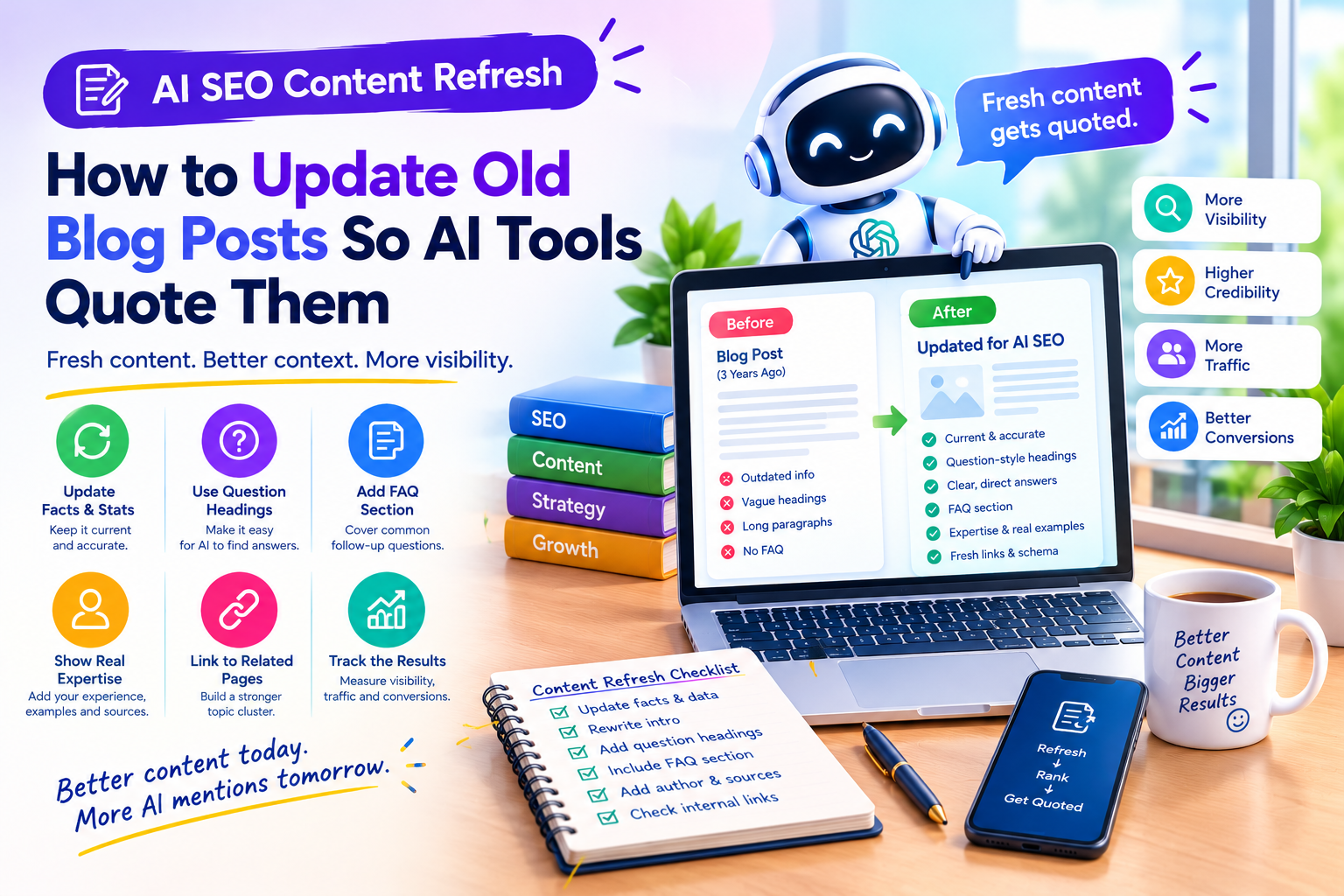
Most websites are sitting on a goldmine they’ve forgotten about: old blog posts. Some were written three years ago for a different kind of search. They still get a little traffic, but AI assistants rarely quote them, because they’re vague, dated or buried in long paragraphs.
The good news is that you don’t always need new content. A smart refresh can give existing posts a second life. Here are the questions we hear most about updating content for AI SEO.
Why does old content struggle in AI answers?
AI tools prefer sources that are clear, current and easy to quote. Older posts often fail on all three counts. They open with long introductions before reaching the point, mention outdated tools or numbers, and rely on loose headings like “Things to Know.”
An AI scanning that page has to dig for the answer, and it may decide a competitor’s cleaner page is a safer source. A refresh fixes exactly these problems.
Which blog posts should I refresh first?
Don’t update everything at once. Start with posts that already have some value:
- Posts with steady traffic that has recently slipped.
- Posts on your core services, since these connect directly to enquiries.
- Posts that answer common customer questions.
- Posts with strong backlinks but weak, outdated content.
Skip posts that are off-topic or no longer relevant to your business. Sometimes the right move is to merge two thin posts into one strong one, or remove content that adds nothing.
How do I rewrite an old post for AI SEO?
Follow a simple five-step routine:
- Check the facts. Update statistics, tools, prices, laws and examples. Remove anything you can’t verify.
- Rewrite the opening. Give the main answer in the first two or three sentences. Save the background for later.
- Sharpen the headings. Turn vague headings into real questions, such as “How long does a website redesign take?”
- Add direct answers. Under each question heading, begin with a short, clear reply, then expand.
- Add an FAQ section. Cover the follow-up questions readers commonly ask.
This structure helps both people and AI tools find the answer in seconds.
Does adding a “last updated” date really help?
It helps, as long as it’s honest. A visible update date tells readers and search systems that the page is maintained. But changing the date without changing the content doesn’t fool anyone, and it can hurt trust.
Only update the date when you’ve made meaningful improvements. A short note such as “Updated October 2026 with new examples” is a nice touch.
What should I add to make old posts more trustworthy?
AI tools lean toward content that shows real experience. Consider adding:
- An author name and short bio, so the page has a real person behind it.
- First-hand examples, such as results you’ve seen, mistakes you’ve learned from or client scenarios.
- Original screenshots or simple data from your own work.
- Links to credible sources when you cite facts.
Generic advice is everywhere now. Specific experience is what makes your page worth quoting. This is the principle behind many content audits at Sarkar SEO, where thin, generic posts are rebuilt around real expertise instead of filler.
How do I connect refreshed posts to the rest of my site?
Think of your blog as a web, not a pile. When you update a post, link it to your relevant service pages, related articles and case studies. Use clear, descriptive link text instead of “click here.”
This helps visitors move naturally through your site, and it helps AI tools understand which topics you cover in depth. A cluster of connected posts on one subject signals real authority, much more than scattered one-off articles.
Should I use AI to rewrite my old content?
Use it as an assistant, not as the author. AI can help you outline, tighten sentences or suggest missing questions. But if you paste in a draft and publish whatever comes back, you’ll end up with the same bland, generic text as everyone else.
Always add your own knowledge, edit for a natural voice and check every fact. Readers can tell when something sounds hollow, and so can quality systems. At Sarkar SEO, we treat AI as a drafting tool and keep humans in charge of accuracy and tone.
How will I know the refresh worked?
Give it a few weeks, then check:
- Whether the page’s impressions and clicks improved.
- Whether the page now appears when you ask related questions in ChatGPT, Gemini and Perplexity.
- Whether the time spent on the page and conversion actions went up.
- Whether the page began earning mentions or links.
Remember that results aren’t instant, and AI answers change from one run to the next. Look for trends across a month or two rather than a single day.
What mistakes should I avoid during a refresh?
- Only swapping a few words and calling it updated.
- Stuffing in keywords instead of improving clarity.
- Deleting useful content that already ranks well.
- Changing the URL without proper redirects.
- Forgetting mobile readability, such as walls of text and giant paragraphs.
What’s a realistic starting plan?
Pick five posts. Spend one focused week updating them with the steps above, then monitor results for a month. If the first batch performs better, repeat the process with the next five. Sarkar SEO can also run a full content audit if you’d like a ranked list of what to refresh, merge or retire.
