




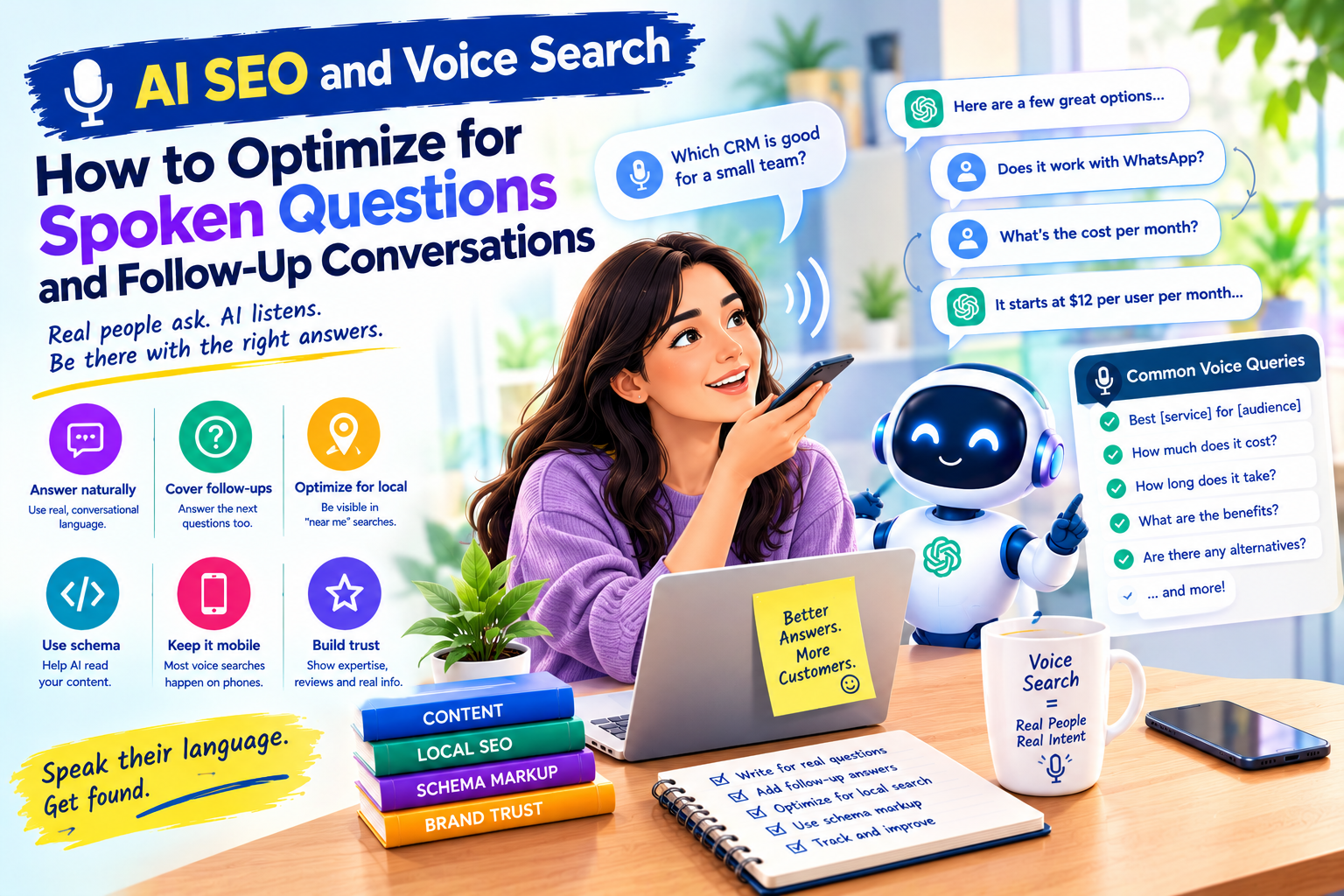
People don’t talk to AI the way they type into a search box. They speak in full sentences, add context and then ask a follow-up. “What’s a good CRM for a small team?” becomes “Which of those works with WhatsApp?” and then “How much would that cost me per month?”
That back-and-forth changes how brands get discovered. Below are the questions we hear most about AI SEO in the age of voice and conversational search.
How is conversational search different from regular search?
Traditional search was a single exchange: a short query and a list of results. Conversational search is a dialogue. The AI remembers what was said earlier, narrows the options step by step and adjusts its suggestions as the person adds detail.
For a brand, this means you aren’t competing for one keyword. You’re competing to stay in the conversation across several questions, from broad research to a final shortlist.
Why does voice search matter for AI SEO?
Voice queries tend to be longer, more natural and more specific. People say “Which dentist near me is open on Sunday and good with kids?” rather than “dentist open Sunday.” Voice assistants and AI chat tools also usually read back one or two answers instead of ten links.
That raises the stakes. When only one answer is spoken, being the clear, quotable source matters more than being one of many listed options.
How should I write content for spoken questions?
Write the way a helpful person would answer out loud:
- Lead with the answer. Open each section with a one- or two-sentence reply.
- Use natural question headings, such as “How long does a website migration take?”
- Keep sentences short and clear. If it sounds awkward read aloud, rewrite it.
- Avoid jargon, or explain it in plain words the first time you use it.
- Add specifics. Numbers, timeframes, locations and conditions make an answer useful.
A good test: read your answer out loud. If a listener could understand and repeat it, you’re on the right track.
What are follow-up questions, and why should I plan for them?
Follow-ups are the next questions people naturally ask once they get an answer. After “What is AI SEO?”, the next ones are usually “How much does it cost?”, “How long does it take?” and “Do I still need normal SEO?”
If your page answers only the first question, the AI has to look elsewhere for the rest, and it may mention a competitor along the way. Map the likely follow-ups for each topic and answer them on the same page or in closely linked pages. Sarkar SEO calls this building “conversation paths,” where each page leads logically to the next question a buyer would ask.
How do I find the questions people really ask?
You already have a source: your own customers. Collect questions from:
- Sales calls and discovery meetings.
- Support emails and chat logs.
- Social media comments and direct messages.
- Google’s “People also ask” boxes.
- Community discussions in your niche.
Group them by stage: early research, comparison and decision. Then make sure you have a clear answer for each stage. Questions about price, timing, risks and alternatives are often the most valuable, because they appear late in the journey, right before a decision.
Does local and “near me” voice search change anything?
Yes. Many spoken queries have local intent, and voice assistants often rely on business listings. Keep your Google Business Profile complete, with accurate hours, services, categories and phone number. Make sure the same details appear on your website and your main directories.
Also add local context to your content. “We offer same-day repairs in Malviya Nagar and nearby areas” works better for a spoken local question than a general promise. And because spoken queries often mix languages in India, include natural Hinglish or Hindi phrasing in your FAQs where it suits your audience.
What technical elements support conversational search?
A few reliable basics:
- FAQ schema so machines can read your questions and answers cleanly.
- Organization and Service schema to clarify who you are and what you offer.
- Fast, mobile-friendly pages, since most voice queries happen on phones.
- Clear heading structure so each answer is easy to locate.
- Crawl access, confirming that search and AI crawlers aren’t blocked.
None of these are glamorous, but they help systems find, understand and trust your answers.
How do I test my content for conversational search?
Run a “conversation test” once a month:
- Pick a core topic, such as your main service.
- Ask ChatGPT, Gemini or Perplexity an opening question, then ask three or four natural follow-ups.
- Note whether your brand appears at any point, and which sources are used.
- Try the same questions by voice on a phone assistant if you can.
- Identify where the conversation drifts away from you and strengthen that content.
Answers vary from run to run, so repeat the test a few times and look for patterns. Sarkar SEO uses this multi-step testing for clients because a single question rarely shows the full picture.
What mistakes should I avoid?
- Writing only for keywords, ignoring natural phrasing.
- Long, dense paragraphs that are hard to quote or read aloud.
- Answering the first question and stopping.
- Ignoring local and language habits.
- Expecting voice traffic to show up neatly in reports. Much of it appears as direct or branded visits, so look at trends, not exact counts.
Where can I begin this week?
Choose one important service page. Add a short, spoken-style answer at the top, five follow-up questions with clear replies, and FAQ schema. Check your business details for consistency, then run the conversation test and note your baseline. If you want a team to build this across your whole site, Sarkar SEO can map the questions and fix the gaps.
