




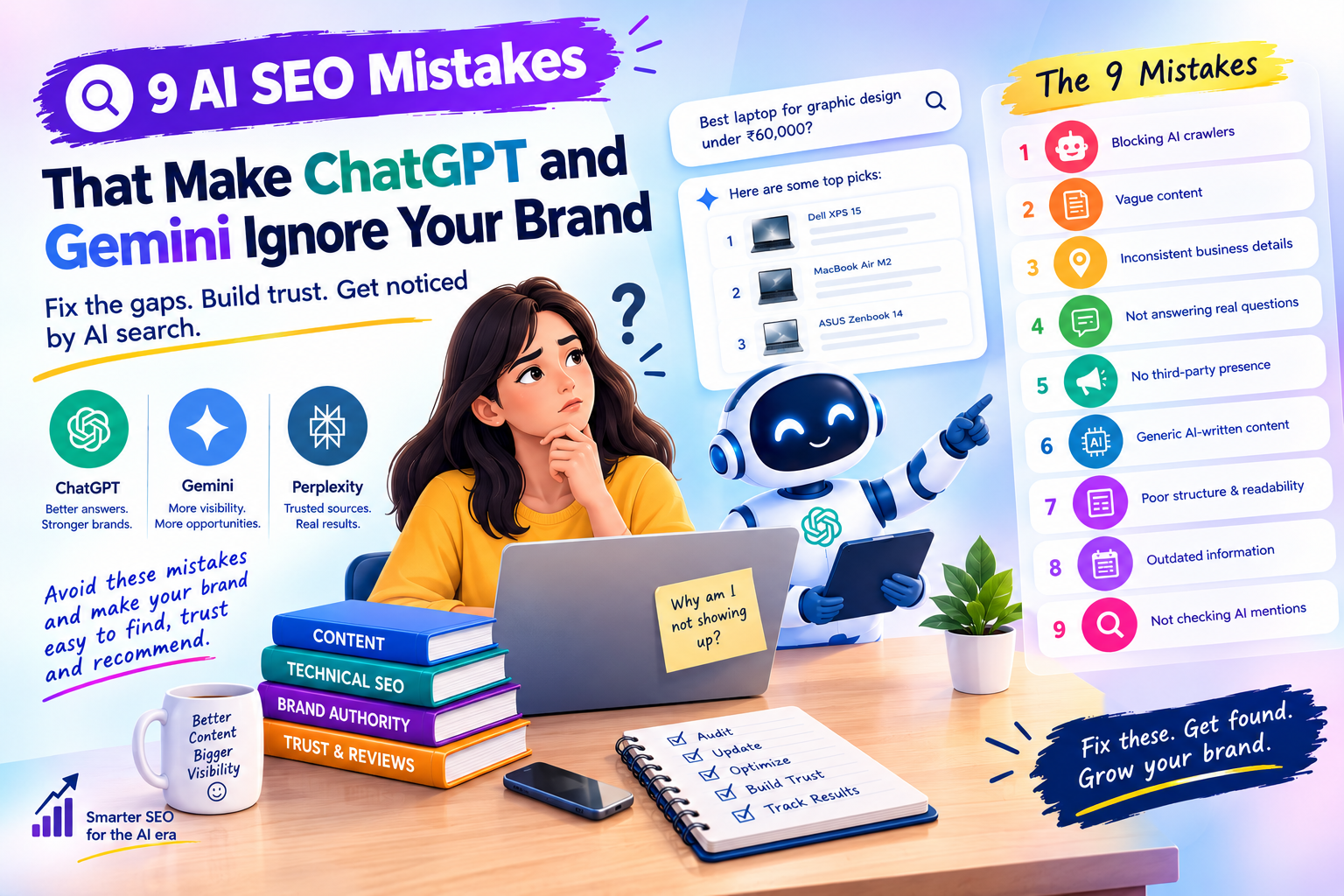
You publish regularly, your site looks good and your Google rankings are decent. Yet when you ask ChatGPT or Perplexity about your industry, your competitors get named and you don’t. It’s a frustrating feeling, and it usually has a cause.
The cause is rarely one dramatic failure. More often it’s a handful of quiet mistakes that make your brand hard for AI to understand or trust. Here are the questions we hear most about AI SEO problems, with practical fixes.
Why would AI ignore a brand that ranks well on Google?
Because ranking and recommending are different jobs. Google ranks pages for a query. An AI assistant builds an answer and decides which brands are safe to mention. To mention you, it needs to understand what you do and find consistent evidence that you’re reliable.
A page can rank well and still give the AI too little to work with. That gap is where most of the mistakes below live.
Mistake 1: Is my website blocking AI crawlers?
It happens more often than you’d think. Overly strict robots.txt rules, security plugins or firewall settings can stop legitimate bots from reading your pages. If they can’t read you, they can’t mention you.
Fix: Review your robots.txt and security settings, and make sure the crawlers you want to allow aren’t blocked. Then confirm that important pages load without logins or pop-ups hiding the content.
Mistake 2: Is my content vague?
Phrases like “innovative solutions” and “world-class service” say almost nothing. AI tools need facts they can repeat: what you offer, for whom, where, and how it works.
Fix: Rewrite key pages with specifics. Name your services, your audience, your location, your process and your pricing approach. If a stranger couldn’t summarize your business after reading one page, an AI can’t either.
Mistake 3: Are my business details inconsistent?
Different phone numbers, old addresses, three versions of your company name and mismatched descriptions across profiles all reduce confidence. AI tools compare sources, and conflicts make them cautious.
Fix: Pick one official version of your name, description, address and contact details, and update every website, directory and social profile to match. Sarkar SEO often finds that this single clean-up improves how accurately AI describes a brand.
Mistake 4: Am I writing content that doesn’t answer real questions?
Many blogs are written around keywords instead of questions. But people ask AI full, conversational questions, and they want direct answers.
Fix: Build content around real customer questions. Put the answer in the first sentence or two, then explain. Use question-style headings and add FAQ sections with short, factual replies. This is the core of Answer Engine Optimization.
Mistake 5: Is my brand invisible outside my own website?
If the only place that describes your business is your own site, the AI has no second opinion. It learns from reviews, directories, publications, forums and expert roundups too.
Fix: Build credible third-party presence. Collect detailed customer reviews, join respected directories in your field, contribute expert commentary and seek features in relevant publications. Quality and relevance matter far more than volume.
Mistake 6: Am I publishing generic AI-written content?
When a page reads like every other page on the topic, it gives the AI no reason to prefer you. Text produced by AI without real input often repeats what already exists.
Fix: Add what only you have: first-hand experience, client examples, original screenshots, honest opinions and local knowledge. Use AI tools to assist, then edit heavily. A distinct voice and real expertise are what make a page worth quoting.
Mistake 7: Is my structure hard to read?
Walls of text, vague headings and key details hidden in images make pages harder for machines and humans alike.
Fix: Use clear headings, short paragraphs, bullet points and tables where they help. Keep important information in real text, not inside graphics. Add schema markup, such as Organization, Article, FAQ and Service, so machines can read your page without guessing.
Mistake 8: Is my information out of date?
Old prices, closed branches, discontinued services and stale statistics make a page unreliable. AI tools lean toward sources that appear current and maintained.
Fix: Review your most important pages every quarter. Update facts, remove what’s no longer true and show an honest “last updated” date when you make real changes.
Mistake 9: Am I never checking what AI actually says?
Many businesses optimize blindly. They never ask the AI about themselves, so they never see the wrong information or missing mentions.
Fix: Run a monthly test. Write 20 to 30 questions your customers might ask, run them in ChatGPT, Gemini and Perplexity, and record whether you appear and how you’re described. When you spot errors, trace them to the source and correct it. At Sarkar SEO, this monthly check is the starting point for almost every AI visibility plan.
How do I know which mistake is hurting me most?
Work through a simple diagnosis:
- If AI doesn’t know you exist, look at crawl access, brand consistency and third-party mentions.
- If AI mentions you but describes you wrongly, look at outdated pages and conflicting profiles.
- If AI mentions competitors for your key questions, look at content depth, answer clarity and reputation signals.
Fix the biggest gap first, then retest after a month.
Will fixing these mistakes guarantee a recommendation?
No, and be wary of anyone who says otherwise. No one controls what an AI chooses to say. What you can do is remove obstacles, strengthen your signals and keep measuring. The brands that do this steadily tend to become the safe, obvious choice over time.
