




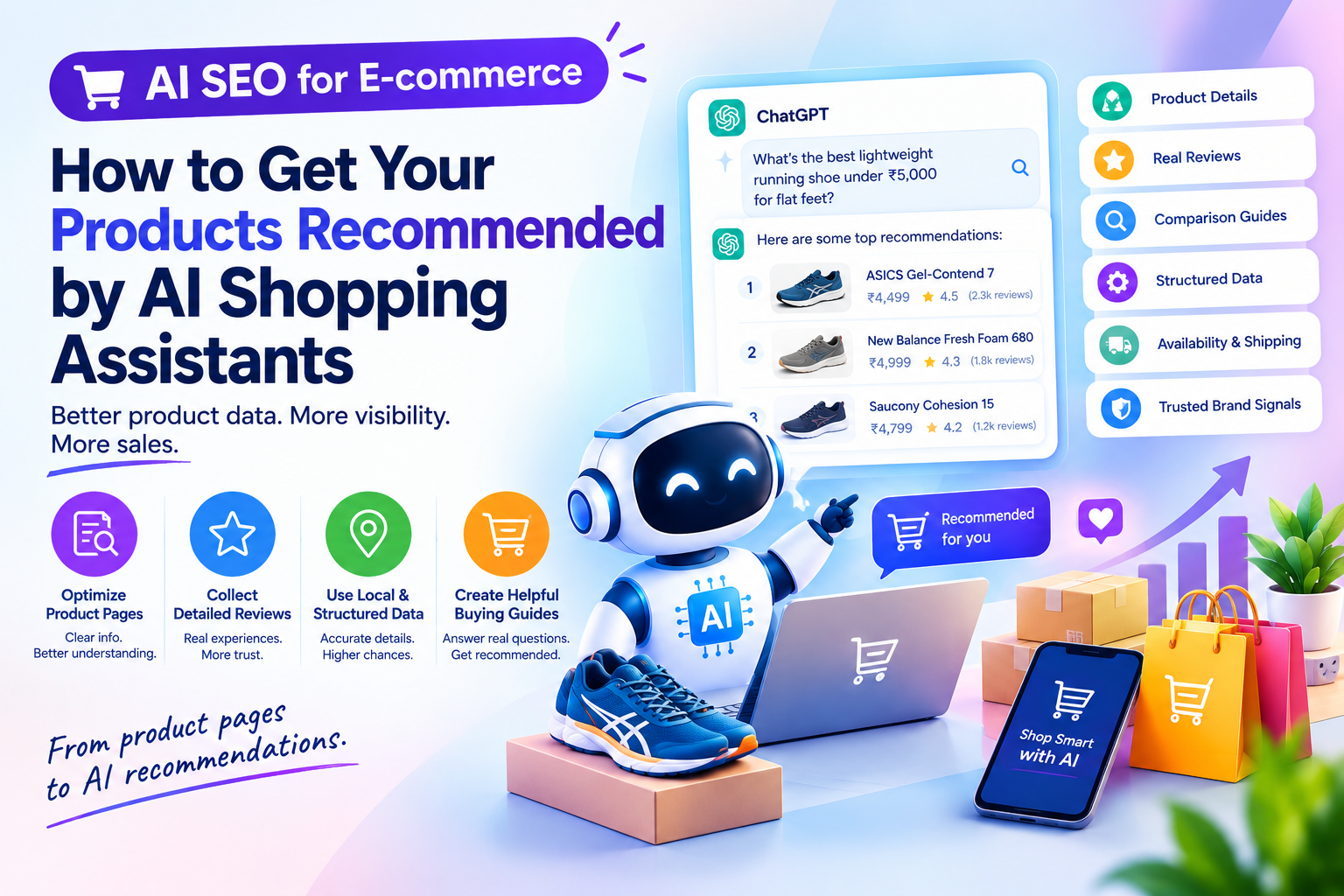
Shopping research is changing. Instead of opening ten tabs, many buyers now ask an AI assistant: “What’s the best lightweight running shoe under ₹5,000 for flat feet?” The answer arrives as a short, confident list of products, often with reasons.
If your store’s products aren’t in that list, the customer may never see them. Here’s how AI SEO works for online stores, answered in the questions sellers ask us most.
Why is AI search a big deal for online stores?
Because AI compresses the buying journey. Traditional shopping search showed you a page of listings and let you compare them yourself. AI assistants do the comparing for you and hand over a shortlist.
That favours stores whose product information is clear, complete and trustworthy. A bigger brand doesn’t automatically win. A well-documented product from a smaller store can beat a poorly described one from a famous name.
What do AI tools look for on a product page?
They look for details they can safely repeat. A product page that says “premium quality, best price” gives the AI nothing to work with. A page that states material, dimensions, use cases, compatibility, warranty and delivery terms gives it plenty.
Make sure each product page clearly covers:
- What the product is and who it’s for.
- Key specifications in plain language.
- What problem it solves, and what it doesn’t.
- Pricing, availability, shipping and return details.
- Real customer feedback.
Think of your page as a briefing document. If an AI had to explain your product to a stranger in three sentences, could it do it accurately using only your page?
How important are reviews for AI product recommendations?
Very. Reviews give AI tools the real-world evidence that product descriptions can’t. They reveal how a product performs, who it suits and where it falls short.
Encourage detailed reviews by asking specific questions, such as “How did it fit?” or “How long did the battery last?” Detailed feedback is far more useful than a bare star rating. Also, respond to reviews honestly. A calm, helpful reply to a complaint can improve how your brand is perceived, and it shows the AI that your business is active and accountable.
Should I create comparison and buying-guide content?
Yes. Shoppers often ask AI comparison questions: “Which is better for a small kitchen, an air fryer or a microwave?” If your site publishes honest guides that answer these questions, you give AI a source to learn from.
Good e-commerce content includes:
- Buying guides. “How to choose a laptop for video editing.”
- Comparison pages. Your product versus a common alternative, with fair pros and cons.
- Use-case pages. “Best backpacks for daily commuting in rainy cities.”
- Product FAQs. Short answers about sizing, care, installation and returns.
Be honest in these pages. Content that admits when a product isn’t the right fit builds more trust, with both readers and AI, than content that praises everything.
What technical steps help AI understand my store?
Several small fixes make a big difference:
- Product schema. Add structured data for price, availability, ratings and brand so machines can read your listings accurately.
- Clean product feeds. Keep titles, descriptions and prices consistent across your site, Google Merchant Center and marketplaces.
- Crawl access. Confirm that your robots.txt and security settings aren’t blocking legitimate crawlers.
- Fast, mobile-friendly pages. Poor performance weakens every other signal.
Sarkar SEO often finds that conflicting product data across platforms is the quiet reason a store gets overlooked, so a feed audit is a smart first step.
Do marketplaces and third-party sites affect AI visibility?
Yes. AI tools learn from more than your own website. Marketplace listings, review platforms, comparison sites and publisher roundups all contribute to how your products are described.
Treat these as part of your AI SEO strategy. Keep your listings accurate, pursue inclusion in credible “best of” articles and make sure your brand name is spelled and described consistently everywhere. A mismatch between your website and your marketplace listing can confuse an AI and reduce its confidence in recommending you.
How can I check whether AI recommends my products?
Run a simple monthly test:
- Write 20 shopping-style questions your customers might ask, including budget, use case and feature-based prompts.
- Ask them in ChatGPT, Gemini and Perplexity.
- Note which products and brands appear, and how they’re described.
- Look for patterns: which questions you win, which you lose and who beats you.
Then update the weakest pages first. This method gives you a clear picture without needing expensive tools, and it’s the same starting point Sarkar SEO uses when auditing an online store.
What mistakes do e-commerce brands make?
- Copying manufacturer descriptions. Identical text across many stores gives AI no reason to prefer yours.
- Ignoring out-of-stock pages. Outdated availability creates a poor experience and unreliable data.
- Hiding key details in images. AI reads text far better than text embedded in pictures.
- Chasing every trend. Focus on accurate information, not gimmicks.
What’s the simplest way to start?
Choose your five best-selling products. Rewrite each page so it answers the questions a buyer would ask, add schema, request detailed reviews and publish one helpful buying guide around them. Then test how AI responds a month later.
If you’d like expert support building a full plan, from product data to content and measurement, Sarkar SEO can help your store earn a place in AI recommendations.
