




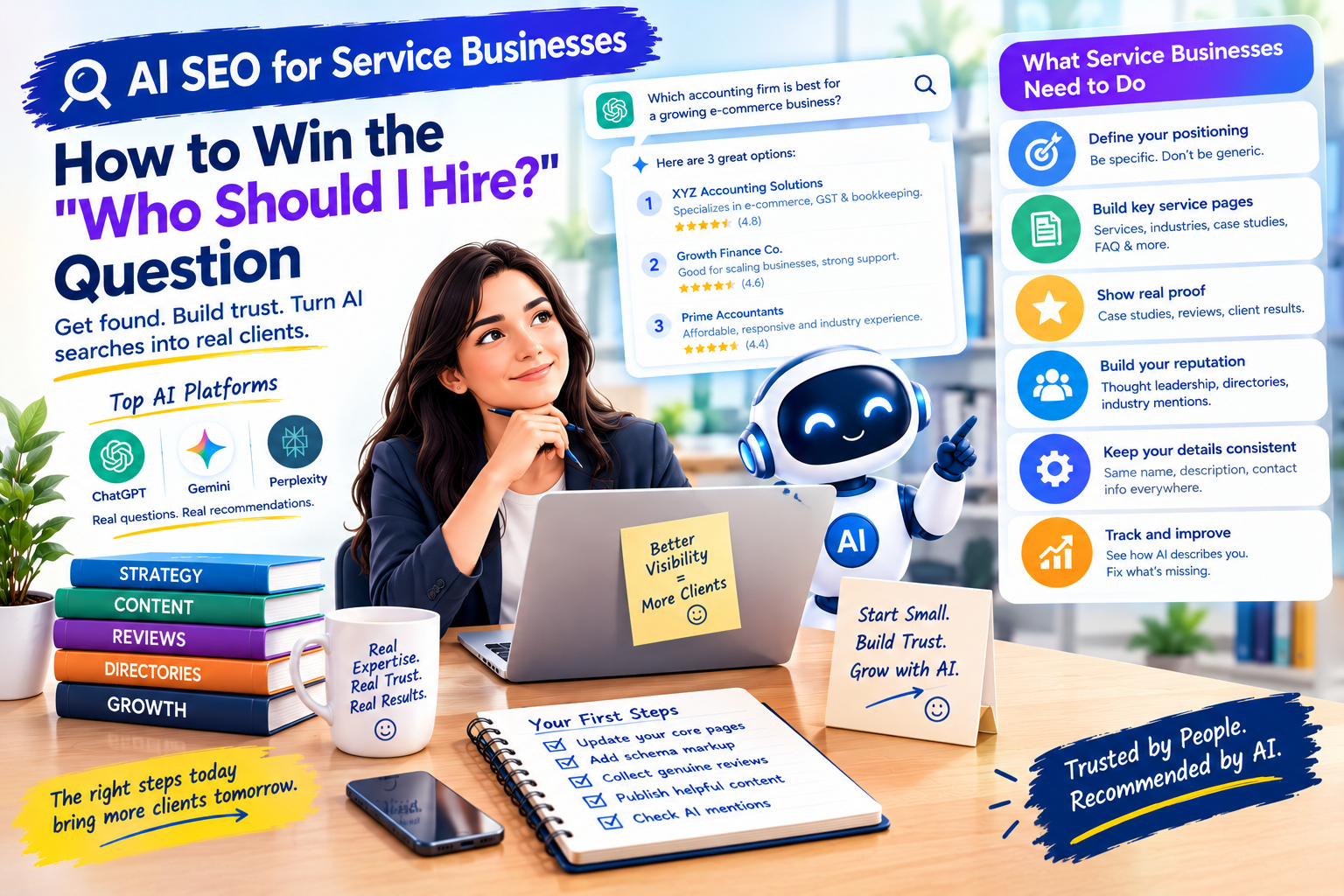
A founder opens ChatGPT and types: “Can you recommend an accounting firm for a growing e-commerce business?” A few seconds later, the AI names three firms and explains why each might fit.
For consultants, agencies and professional service providers, this moment is becoming a new front door. Service buyers are cautious, they compare carefully and they love shortcuts. AI gives them one. Here are the questions we hear most about AI SEO for service businesses.
Why are “who should I hire” queries so valuable?
They come from people who are already close to a decision. Someone asking for a recommendation usually has a problem, a budget and a deadline. Being named at that moment carries more weight than a generic search impression.
It also shortens the sales cycle. When an AI introduces your firm as a credible option, prospects arrive with some trust already in place.
How does AI decide which service providers to mention?
It looks for clarity and corroboration. Clarity means your website states exactly what you do, for whom and where. Corroboration means other sources agree: client reviews, directory profiles, case studies, press mentions and expert commentary.
Vague positioning is the biggest obstacle. “We provide end-to-end business solutions” tells an AI almost nothing. “We provide bookkeeping and GST compliance for online sellers with up to 50 employees” gives it something concrete to match against a buyer’s question.
How specific should my positioning be?
More specific than feels comfortable. Many service firms worry that narrow positioning will cost them clients. In AI search, the opposite often happens. A narrow description makes you the obvious answer to a narrow question.
Try completing this sentence: “We help [specific customer] with [specific problem] by [specific method].” Then reflect that sentence on your homepage, service pages, social profiles and directory listings.
What pages does a service website need?
Think in terms of the questions a cautious buyer asks:
- Service pages, one per core offering, with scope, process, timeline and who it suits.
- Industry pages, if you serve distinct sectors, with relevant examples.
- Pricing or “how pricing works” pages, because buyers always ask and AI tools like concrete answers.
- Case studies, with the problem, approach and results explained honestly.
- FAQ pages, covering contracts, timelines, onboarding and what happens if things go wrong.
- An about page, naming real people with real experience.
Each page should be written for a person first. If it helps a nervous buyer decide, it will usually help an AI summarize you accurately too.
How important are case studies and proof?
Extremely. Services are intangible, so proof does the heavy lifting. A good case study explains the starting situation, what you did, what changed and what you learned, including what didn’t go perfectly.
Use real numbers only when you can verify them, and get client permission before publishing names. Vague boasts like “we delivered amazing results” add nothing. At Sarkar SEO, we encourage clients to document their proof in this structured, honest format, because it gives both buyers and AI tools something solid to rely on.
Does thought leadership help AI mention my firm?
It can, when it’s genuine. AI tools learn who is associated with which topics. If your team regularly publishes insightful articles, speaks at events, contributes to industry publications and shares practical advice, your name becomes linked with your specialty.
Focus on depth over frequency. One original, experience-based article does more than five recycled ones. Put real names on your content, add short author bios and link to your team’s profiles so your expertise is easy to verify.
How should I handle reviews and directories?
Treat them as part of your sales process. After a successful project, ask clients for a detailed review on the platforms your buyers use, such as Google, LinkedIn, Clutch-style directories or industry associations. Detailed feedback that mentions the problem, the process and the outcome is far more useful than a star rating alone.
Keep your profiles complete and consistent, with the same firm name, description and contact details everywhere. Conflicting information makes AI tools cautious.
How can I test whether AI recommends my firm?
Use a simple monthly routine:
- Write 20 questions a buyer might ask, such as “best [service] for [type of company]” and “how to choose a [service] provider.”
- Run each in ChatGPT, Gemini and Perplexity.
- Record whether you appear, which competitors appear and how each firm is described.
- Note which sources are cited.
Over time, you’ll see which questions you win and which need work. Sarkar SEO builds this kind of tracking into client reports so decisions rest on real answers, not assumptions.
What mistakes do service businesses make?
- Trying to serve everyone, which makes the firm sound like everyone else.
- Hiding pricing and process, leaving buyers and AI with no details.
- Publishing case studies without substance.
- Letting profiles go stale after a rebrand or team change.
- Promising guaranteed AI rankings to prospects, which no honest firm can do.
Where should I start?
Rewrite your positioning sentence. Update your top three service pages to answer buyer questions clearly. Publish one detailed case study. Ask three recent clients for specific reviews. Then run your question list and note the baseline.
If you’d like experienced help turning this into a full plan, Sarkar SEO can audit how AI currently describes your firm and show you what to fix first.
