




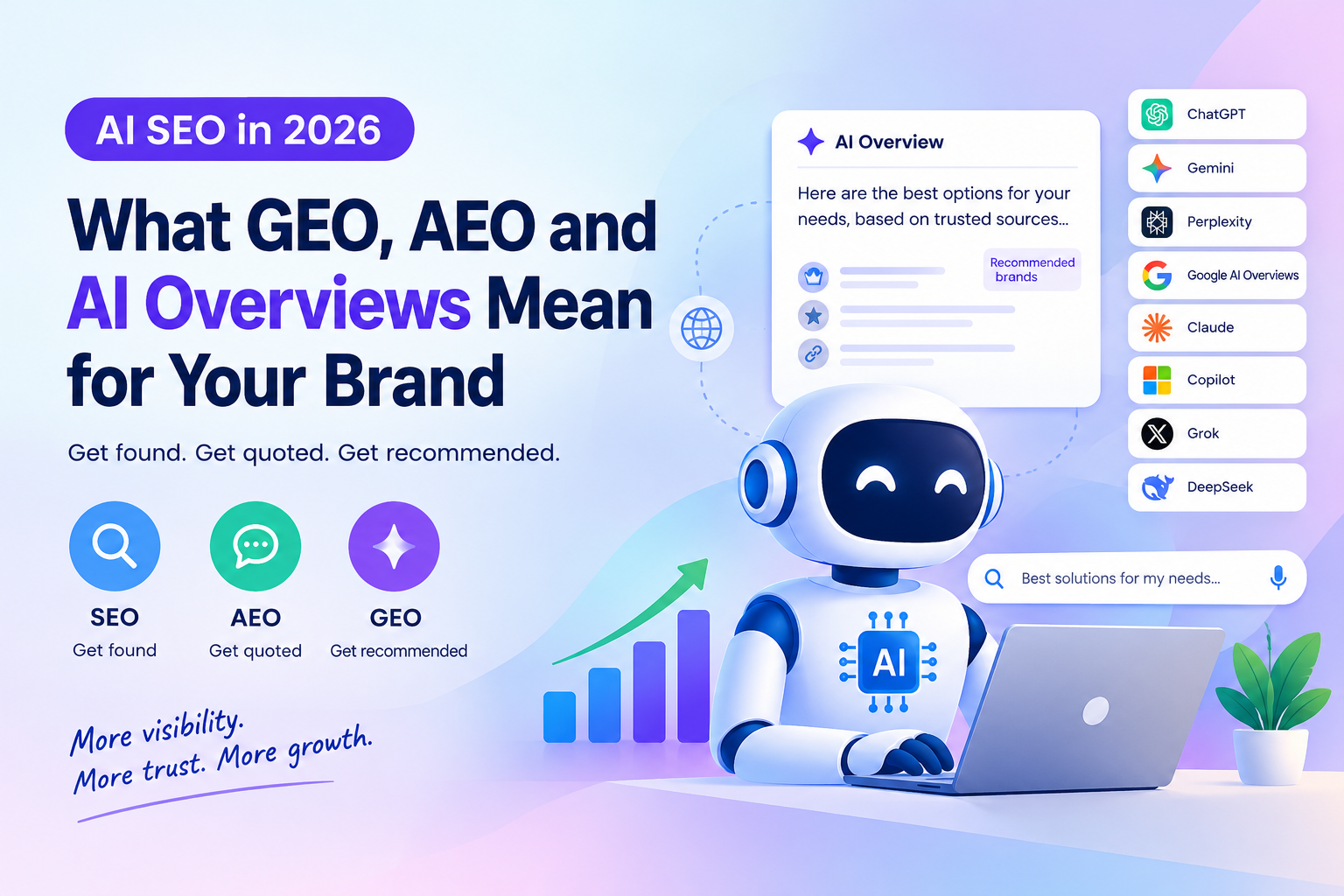
Search used to be simple. You typed a query, scanned ten blue links, and clicked one. Today, many people never get that far. ChatGPT, Gemini, Perplexity and Google’s AI Overviews hand them a finished answer, often with a few brand names already chosen.
That shift is why AI SEO has become one of the most searched topics in digital marketing. Below are the questions business owners ask us most, answered plainly.
What is AI SEO, and how is it different from traditional SEO?
AI SEO is the practice of making your brand easy for AI systems to find, understand, trust and mention. Traditional SEO asks, “How do I rank higher on a results page?” AI SEO asks, “How do I become part of the answer?”
The difference matters because the goals are different. A ranking earns you a click. A citation or recommendation earns you trust before the click even happens. Keywords and backlinks still count, but clarity, consistency and credibility across the web now count just as much.
What is the difference between GEO, SEO and AEO?
The three terms overlap, but each has its own focus:
- SEO (Search Engine Optimization) improves your visibility in traditional search results.
- AEO (Answer Engine Optimization) structures your content so it can be lifted as a direct answer, such as a featured snippet, a voice reply or an AI summary.
- GEO (Generative Engine Optimization) builds the signals that make AI models mention and recommend your brand inside the answers they generate.
Think of it this way: SEO gets you found, AEO gets you quoted, and GEO gets you recommended. A strong strategy uses all three. At Sarkar SEO, we treat them as one connected system rather than three separate services.
How do I get my brand into Google AI Overviews?
There is no secret switch, but there are clear patterns. Pages that appear in AI Overviews tend to answer a question quickly, then support the answer with depth.
- Start each section with a direct, one- or two-sentence answer.
- Use question-style headings that match how people actually speak.
- Add FAQ sections with short, factual replies.
- Use schema markup (FAQ, Organization, Article) so machines can read your page easily.
- Show real expertise: named authors, original examples and up-to-date information.
Also remember that AI Overviews draw on pages Google already considers helpful and trustworthy. Technical health, fast loading and clean site structure still matter.
How do I track brand visibility across AI search engines?
This is where most businesses get stuck, because AI answers don’t come with a rankings report. Here is a practical method you can start today:
- Make a list of 20 to 30 questions your customers really ask.
- Run them through ChatGPT, Gemini, Perplexity and Google AI Overviews.
- Record whether your brand is mentioned, which competitors appear, and which sources are cited.
- Repeat monthly and compare.
Over time you’ll see a pattern: which topics you own, where competitors dominate and which sources the AI trusts. Sarkar SEO uses this kind of prompt-based tracking to turn guesswork into a clear visibility baseline for clients.
Does AI SEO replace regular SEO?
No. AI tools still rely on the open web, and the open web is still shaped by good SEO fundamentals: crawlable pages, strong content, relevant links and a trustworthy reputation. AI SEO builds on that foundation. If your basics are weak, no amount of AI-focused tweaking will fix it.
Why do brand mentions matter so much now?
AI models learn from patterns. When your brand is described consistently across your website, reviews, forums, news sites and industry directories, the AI becomes more confident about who you are and what you do. When the information conflicts, such as different addresses, vague service descriptions or outdated pages, the AI hesitates, and it usually picks a competitor instead.
So consistency is no longer a minor detail. Your name, services, location and expertise should read the same everywhere.
Where should a business start this month?
Keep it simple and do these five things first:
- Audit your top pages. Add clear answers and FAQ blocks to the ones that matter most.
- Fix your entity details. Make sure your brand information matches across every profile.
- Publish original content. Case studies, data and real experience stand out from generic AI-written text.
- Earn mentions, not just links. Get featured in credible publications and communities in your niche.
- Measure monthly. Track AI visibility the way you track rankings.
If you’d rather have experts handle the heavy lifting, Sarkar SEO builds AI SEO strategies around exactly these steps, tailored to your industry and goals.
