




For years, the SEO scoreboard was simple: keyword positions, organic traffic and backlinks. Those numbers still matter, but they no longer tell you whether AI tools are mentioning your brand. You can hold the number one spot on Google and still be missing from the answer a customer reads in ChatGPT.
That gap leaves many marketers unsure what to report. Here are the questions we hear most about measuring AI SEO.
Why aren’t rankings enough anymore?
Rankings measure position on a results page. AI answers don’t have a results page. They have a short response, and your brand is either in it or not. Even Google now places AI-generated summaries above the traditional listings for many queries.
This means a page can rank well and still lose visibility, because the user got what they needed without clicking. Measuring AI SEO requires new indicators that capture presence, accuracy and influence, not just position.
Which KPIs matter most for AI SEO?
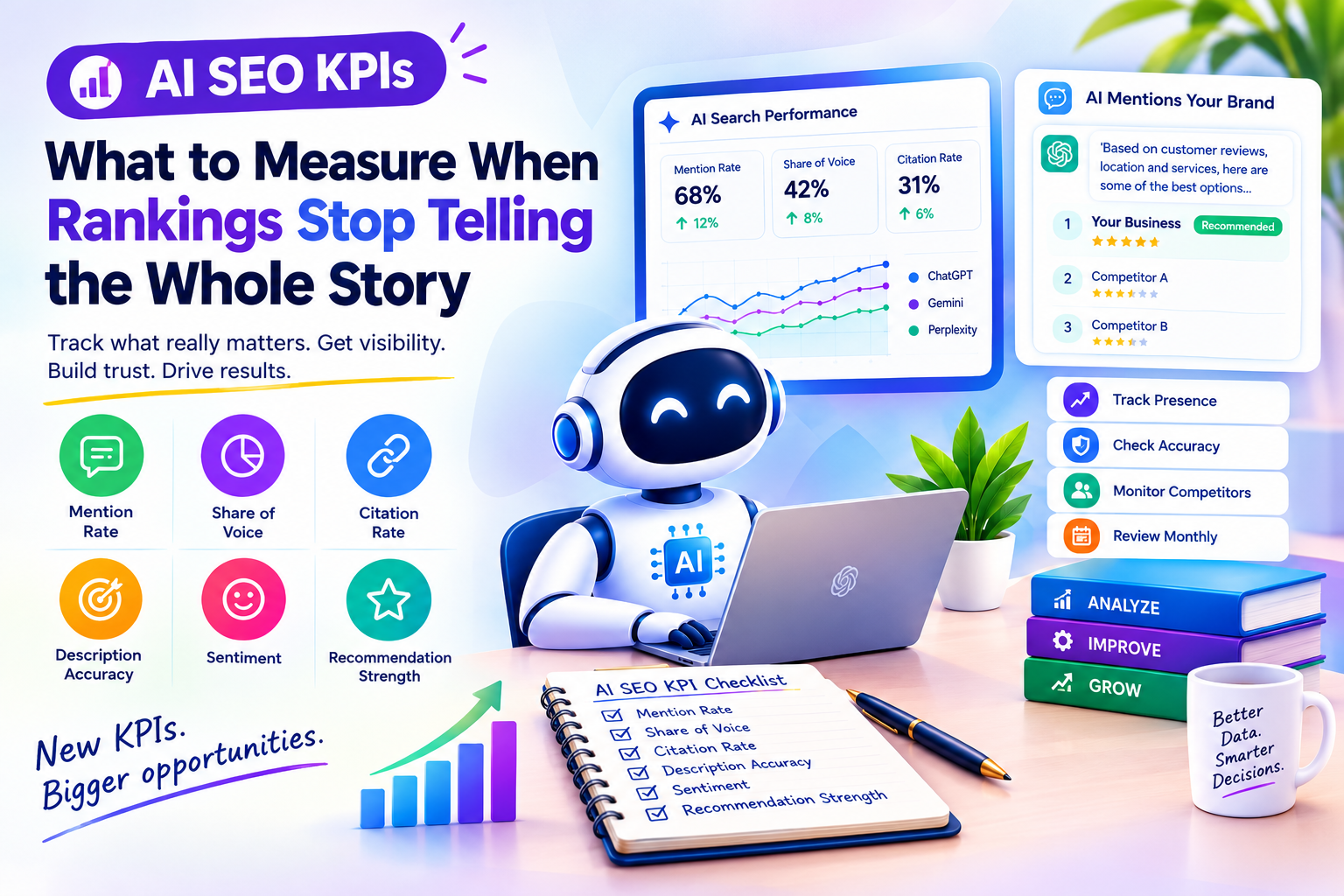
Focus on a small, meaningful set instead of drowning in dashboards:
- Mention rate. Out of your tracked questions, how often does your brand appear?
- Share of voice. When AI lists options in your category, what portion of the time are you named compared with competitors?
- Citation rate. How often does an AI answer link to or reference your own website?
- Description accuracy. Does the AI describe your services, location and pricing correctly?
- Sentiment. Is your brand described positively, neutrally or with caveats?
- Recommendation strength. Are you named as a top choice, or just listed among many?
The last two are easy to overlook, but they often matter most. Being mentioned with the wrong information can be worse than not being mentioned at all.
How can I tell if AI is sending me traffic?
This is trickier than it sounds, because many AI interactions don’t produce a clean click. Still, you can build a useful picture:
- Check referral sources. In your analytics, look for visits coming from AI platforms such as chatgpt.com or perplexity.ai.
- Watch branded search. If more people start searching your company name directly, AI exposure may be planting the seed.
- Monitor direct traffic. A steady rise in direct visits can signal people typing your address after an AI recommendation.
- Ask customers. Add “How did you hear about us?” to forms and calls, with an option like “AI assistant.”
No single signal is perfect. Together, they reveal a trend. Sarkar SEO combines these indicators in client reports so the story isn’t based on guesswork.
Are impressions and clicks still useful?
Yes, but read them with care. Search impressions may rise while clicks fall, because AI summaries answer more questions on the page. That pattern doesn’t necessarily mean your SEO is failing. It may mean users are getting information without visiting.
The smarter question is what happens after exposure. Look at conversion rate, enquiry quality and the time it takes a visitor to decide. Fewer visitors who are better informed often convert better than a large volume of casual browsers.
How do I measure whether AI is describing my brand correctly?
Treat it like a quality check. Each month, run your tracked questions and read the answers closely. Score each one on a simple scale:
- Is the information factually correct?
- Is it current?
- Does it match how you want to be positioned?
- Are your key services mentioned?
When you find errors, trace them back. Often the AI is repeating an old directory listing, an outdated page or a conflicting profile. Fixing the source usually fixes the answer over time. This kind of error-tracing is a routine part of how Sarkar SEO handles brand accuracy for clients.
How often should I review these numbers?
Monthly is the sweet spot for most businesses. Weekly checks tend to create noise, because AI answers vary from one run to the next. Test each question more than once and focus on direction over time, not a single result.
Every quarter, step back and ask bigger questions. Has your share of voice grown? Are you winning new kinds of questions? Are competitors gaining ground?
What should I stop measuring?
Don’t throw away the old metrics, but demote the ones that mislead:
- Keyword rankings as a lone success signal. Useful context, not the whole story.
- Raw traffic totals. Quality and intent matter more than volume.
- Vanity mentions. A passing mention inside a long list is weaker than a clear recommendation.
How do I report AI SEO results to my boss or client?
Keep it simple and visual. A one-page report works well:
- Your mention rate and share of voice versus two or three competitors.
- A few real screenshots of AI answers that mention your brand.
- Referral and branded-search trends.
- Errors found and fixes made.
- Next month’s priorities.
Screenshots are powerful because they show exactly what customers see. They turn an abstract idea into something decision-makers understand in seconds.
