




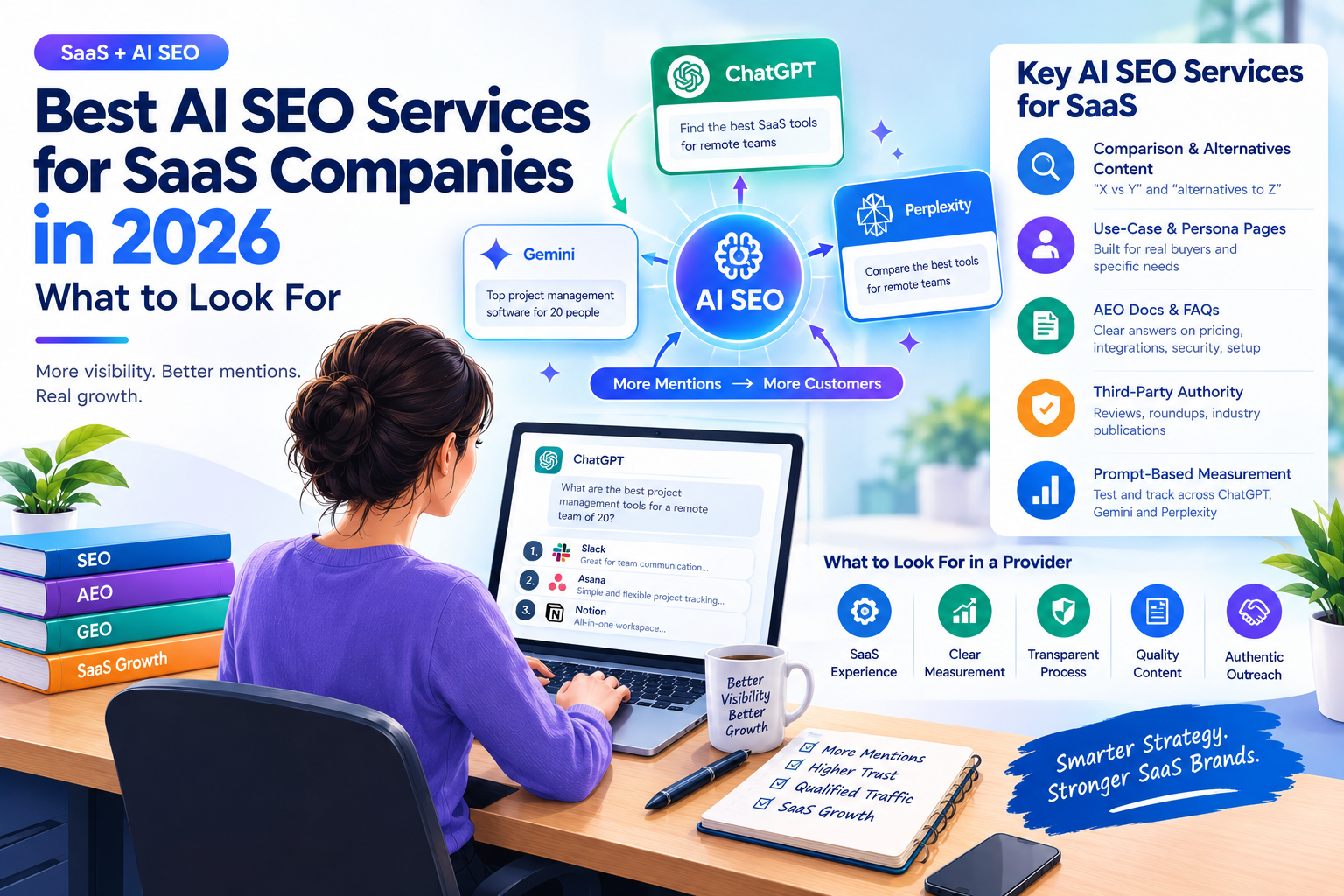
SaaS buyers have changed how they research. Before they ever book a demo, many now ask an AI tool something like “what’s the best project management software for a remote team of 20?” and shortlist whatever gets named.
That makes AI SEO a serious growth channel for software companies, and also a crowded one, with every agency claiming to do it. This guide explains which services actually matter for SaaS, how to judge providers, and what to ask before signing anything.
Why is AI SEO different for SaaS companies?
SaaS is a comparison-heavy category. Buyers ask AI tools for “best X for Y,” “alternatives to Z,” and “X vs Y.” Those are exactly the prompts where a model names a handful of products and explains why.
Your product also changes often. Features, pricing and integrations shift, so outdated information spreads fast and can lead AI answers to describe you inaccurately. SaaS AI SEO is as much about accuracy and consistency as it is about visibility.
Which AI SEO services matter most for SaaS?
Look for providers who cover these five areas:
- Comparison and alternatives content. Honest, well-structured pages for “[you] vs [competitor]” and “alternatives to [competitor],” written so a model can extract a fair summary.
- Use-case and persona pages. Pages built around specific buyers, such as “CRM for real estate teams,” which map directly to the way people prompt.
- AEO-style documentation and FAQs. Clear answers about pricing, integrations, security and setup, which are the questions AI tools get asked most.
- Third-party authority building. Presence on review platforms, in software roundups, and in credible industry publications.
- Prompt-based measurement. Regular testing of buyer-style prompts across ChatGPT, Gemini and Perplexity.
If a proposal skips measurement, treat it as a warning sign.
What should a SaaS company ask an AI SEO provider?
Bring these questions to the first call:
- Have you worked with software or subscription products, and can you describe the approach, not just the outcome?
- How will you baseline our current AI visibility?
- How do you handle comparison content without making unfair or misleading claims?
- Which review sites and publications do you consider relevant for us?
- How often will we get reports, and what will they show?
A good provider answers in specifics. A weak one answers in slogans.
How much should we rely on review platforms?
A lot more than most SaaS teams assume. Independent reviews describe your product in customers’ own words, which gives AI models an outside view to check against your marketing. Detailed reviews that mention a use case, a team size and a result are more useful than a pile of short five-star ratings.
Keep your profiles complete and consistent, respond to feedback, and encourage customers to be specific.
Does content volume matter more than content quality?
Quality wins. Publishing fifty thin articles rarely helps. A smaller set of genuinely useful pages, such as an honest comparison, a clear pricing explanation and a strong integrations guide, is more likely to be quoted.
Sarkar SEO generally recommends SaaS clients start with their ten most commercially important pages, rebuild them for clarity and quotability, and expand only once those are working.
What technical work should be included?
Don’t skip the basics. A solid AI SEO service for SaaS should cover:
- Fast, crawlable pages, including documentation and help centers
- Schema markup for your organization, product and FAQs
- Clean site structure so pricing, features and integrations are easy to find
- Consistent naming of your product and features everywhere
- Pages that stay current when your product changes
Many SaaS sites hide their best answers inside gated PDFs or JavaScript-heavy pages that are harder to read. Making that information visible and plain often delivers quick improvements.
What results can we realistically expect?
Be careful with promises. AI answers vary by prompt, platform and time, so no one can guarantee a particular placement. Narrow queries, such as a specific use case or a niche comparison, can respond within weeks. Broad category queries usually take longer because they depend on accumulated authority.
A trustworthy service will set expectations around trend lines: more mentions across your prompt set, more accurate descriptions, and improved positioning against named competitors.
Should early-stage startups invest in AI SEO?
Often yes, because the work rewards clarity, and young companies can build that from the start. Early-stage teams usually do best by choosing a narrow niche, publishing a few high-quality pages, collecting early customer reviews, and tracking a small set of prompts. You don’t need an enterprise budget to begin.
At Sarkar SEO, we scale the scope to the stage of the company rather than selling one package to everyone.
How do we compare providers fairly?
Build a simple scorecard: relevant experience, measurement method, transparency, content quality, authenticity of outreach, and reporting. Ask each provider to run a short prompt audit on your brand so you can compare real output, not sales decks.
The bottom line
The best AI SEO service for a SaaS company is one that understands comparison-driven buying, builds credible third-party evidence, keeps information accurate, and measures honestly.
If you’d like to see how your software brand appears in AI answers today, Sarkar SEO can run a prompt-based audit and outline a clear starting plan.
