




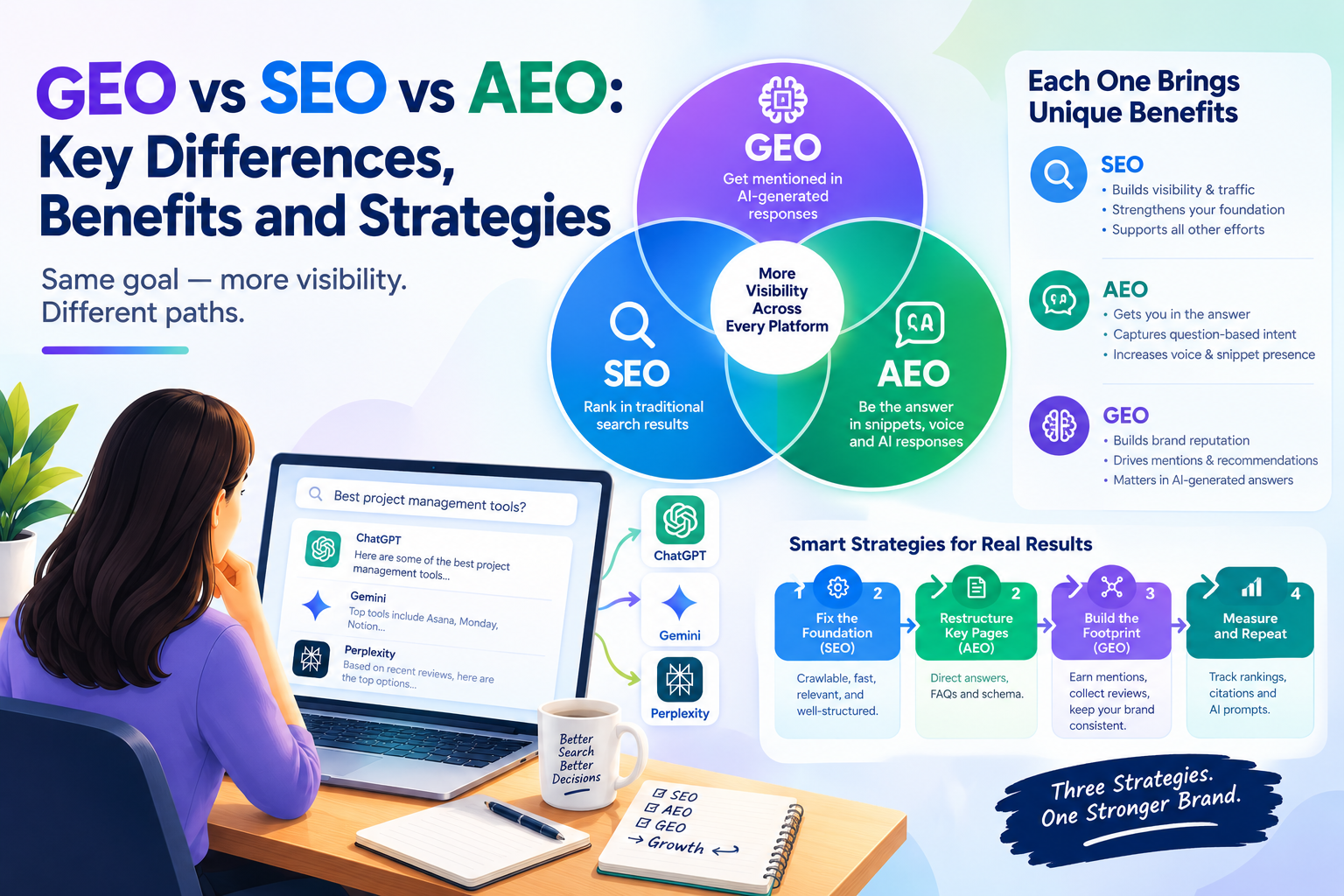
If you’ve read anything about AI SEO this year, you’ve seen three acronyms thrown around as if everyone already agrees on what they mean. SEO, AEO and GEO overlap, but they aren’t the same job, and mixing them up leads to wasted budget.
This guide separates them in plain language, shows what each one is good for, and explains how to combine them without tripling your workload.
What is SEO, and does it still matter?
SEO (Search Engine Optimization) is the practice of helping your pages rank in traditional search results. It covers technical health, content relevance, internal structure and backlinks.
It still matters, and not only for Google. AI tools that search the web in real time often rely on pages that already rank well and are easy to crawl. Weak SEO makes every other effort harder.
What is AEO?
AEO (Answer Engine Optimization) is about being the page that gives the answer. Think featured snippets, voice assistants, and AI responses that quote a source.
The work is mostly on-page: question-style headings, short direct answers, FAQ sections, clear definitions and structured data. AEO asks, “Is this content easy to extract and quote?”
What is GEO?
GEO (Generative Engine Optimization) is about how AI models describe your brand when they write their own answers. Here the focus moves beyond your website to the whole web: reviews, editorial mentions, community discussions, directories and expert profiles.
GEO asks, “When a model summarizes my category, do I come up, and how am I described?”
How do they compare side by side?
| SEO | AEO | GEO | |
| Main goal | Rank pages | Be the quoted answer | Be named and recommended |
| Where it works | Search result pages | Snippets, voice, AI answers | AI-generated responses |
| Core levers | Technical health, links, relevance | Structure, clarity, schema, FAQs | Entity clarity, third-party mentions, reputation |
| Success looks like | Higher rankings and clicks | Your text appears as the answer | Your brand appears in recommendations |
What are the benefits of each?
- SEO builds a durable base of visibility and traffic, and supports everything else.
- AEO gets your expertise in front of people at the exact moment they ask a question, often before they click anything.
- GEO shapes the reputation AI carries about you, which matters most when a buyer asks for a recommendation.
Each one alone leaves a gap. Strong SEO without GEO can mean good rankings but no mention in AI answers. Strong GEO without SEO can mean a good reputation on a site nobody can crawl properly.
Do I need all three?
For most businesses, yes, but not in equal measure from day one. A local service business may get more from AEO and review-driven GEO. A SaaS company comparing itself with ten rivals needs GEO and category authority sooner. A brand with technical problems should fix SEO first.
At Sarkar SEO, we begin every engagement with a short audit across all three, then decide where the first 90 days of effort should go.
What’s a sensible order of operations?
- Fix the foundation (SEO). Make sure pages load fast, are crawlable, and aren’t contradicting each other.
- Restructure key pages (AEO). Add direct answers, FAQs and schema to your highest-value pages.
- Build the footprint (GEO). Earn credible mentions, collect detailed reviews, and keep your brand description consistent everywhere.
- Measure and repeat. Test real prompts monthly and adjust.
This sequence works because each layer supports the next.
What mistakes do businesses make most often?
- Treating GEO as a trick. Fake reviews and mass-produced placements tend to be discounted, not rewarded.
- Abandoning SEO. Dropping the basics because “AI is the future” undermines the foundation.
- Writing for algorithms, not people. Content that reads as robotic is less likely to be trusted or quoted.
- Measuring only clicks. Some AI exposure never produces a click, so you need prompt-based tracking too.
How do I measure each one?
For SEO, use rankings, impressions and organic traffic. For AEO, watch featured snippets and how often your pages are cited. For GEO, run a fixed list of customer-style prompts across ChatGPT, Gemini and Perplexity, and record whether you’re named and how you’re described. Sarkar SEO reports across all three so clients see one clear picture instead of three disconnected dashboards.
Is one of them “replacing” the others?
No. They’re layers of the same visibility stack. SEO makes you findable, AEO makes you quotable, and GEO makes you trusted. As AI answers take up more of the search experience, the top layers gain importance, but they still rest on the bottom one.
The bottom line
Don’t pick a winner among SEO, AEO and GEO. Learn what each does, sequence them sensibly, and measure all three.
Want to know which one deserves your attention first? Sarkar SEO can audit your current position and give you a clear, prioritized plan.
