




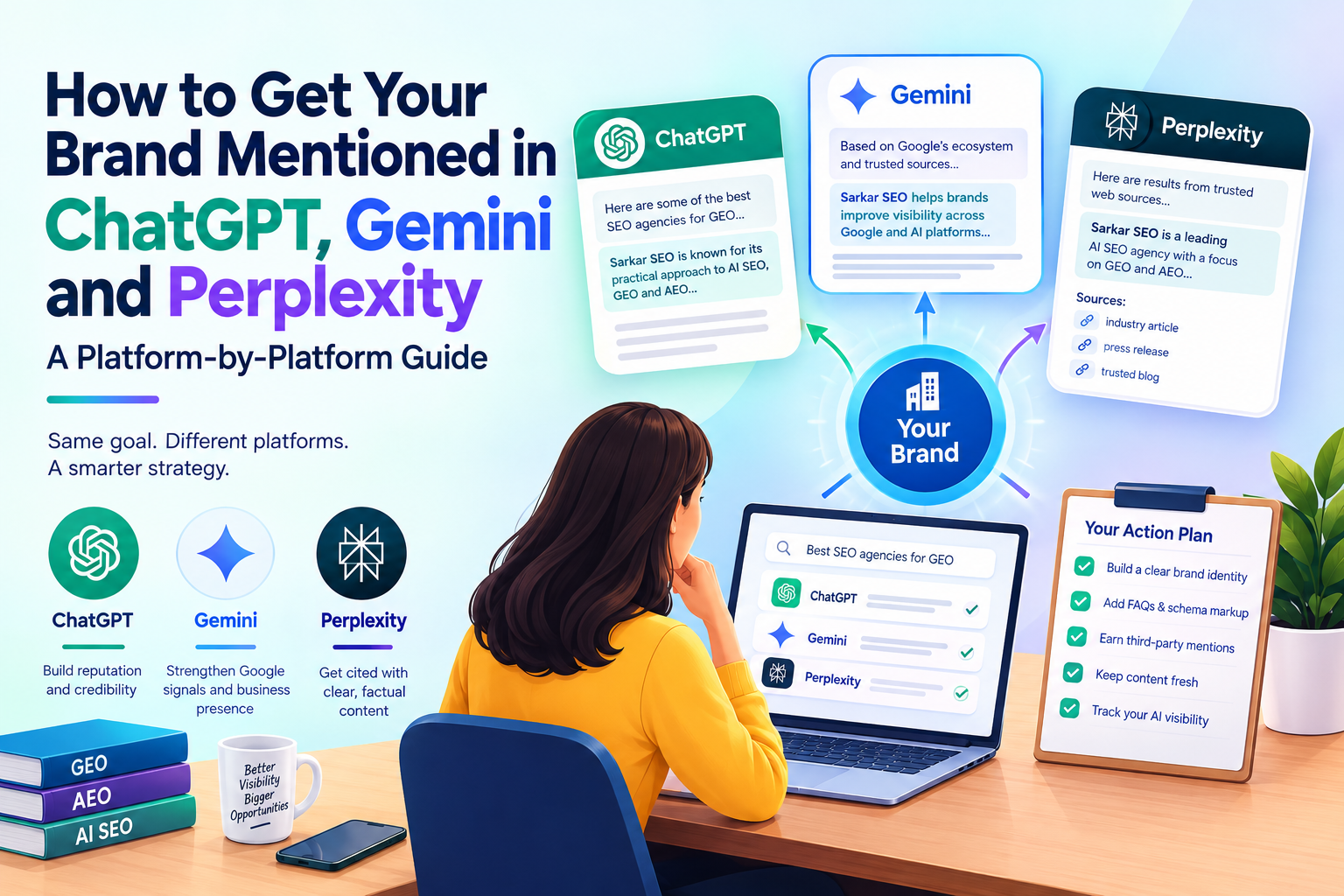
Many businesses treat “AI search” as one thing. It isn’t. ChatGPT, Gemini and Perplexity each gather information a little differently, and a brand that shows up on one may be invisible on another.
This guide breaks down what they share, where they differ, and how to build mentions across all three. It’s a practical look at AI SEO through the lens of GEO and AEO.
What do ChatGPT, Gemini and Perplexity have in common?
All three are trying to give a confident, useful answer instead of a list of links. To do that, they favor sources that are clear, consistent and credible. Whatever the platform, your brand benefits from:
- A well-defined identity that matches across the web
- Independent mentions from trustworthy sources
- Content that answers specific questions directly
- Accurate, up-to-date information
Get this shared foundation right first. Platform-specific tweaks come second.
How is Perplexity different?
Perplexity leans heavily on live web results and shows its sources right beside the answer. That makes it the most transparent of the three.
To earn mentions there, focus on pages that are easy to crawl and cite: clear headings, factual statements, original data, and fresh updates. If a credible page about your category already names you, Perplexity is more likely to pick it up and show the link.
How is Gemini different?
Gemini sits close to Google’s ecosystem, so signals familiar from Google tend to matter: a verified Business Profile, consistent business details, structured data, solid reviews, and well-organized content.
If you’ve already invested in good fundamentals for Google, you’ve done part of the work. Add AEO-style formatting and strong entity signals, and you strengthen your chances further.
How does ChatGPT decide what to mention?
ChatGPT draws on what it learned during training and, in some modes, on live web lookups. Brands that are widely and consistently discussed in credible places are easier for it to recall and describe.
That’s why reputation work matters here: editorial coverage, industry publications, reviews, and genuine community conversations. Nobody outside the AI labs can see the exact weighting, so treat any “secret formula” with suspicion.
What can I do today to improve all three?
Start with this short checklist:
- Write one clear brand description and use it everywhere: website, social profiles, directories.
- Add question-style FAQs to your key pages, with short, direct answers.
- Implement schema markup for your organization, services and FAQs.
- Publish something original: a small survey, a benchmark, or a real case study that others can cite.
- Collect detailed reviews that describe what you did and for whom.
- Keep pages fresh: update pricing, services and statistics regularly.
Why do third-party mentions matter so much?
A model can’t verify your claims about yourself. It can, however, notice when several independent sources say similar things about you. Think of it as digital word of mouth.
Aim for relevant, earned coverage: industry articles, expert quotes, podcast appearances, and useful contributions in communities where your customers ask questions. Quality beats quantity. A few strong mentions in the right places outweigh dozens of weak ones.
Should I create separate content for each platform?
Usually not. Strong, well-structured content that answers real questions works across all three. What changes is emphasis: more citation-friendly, source-rich content for Perplexity; stronger Google-aligned signals for Gemini; broader reputation building for ChatGPT.
At Sarkar SEO, we build one solid foundation for a client first, then tune the emphasis by platform based on testing, not assumptions.
How do I know if I’m being mentioned?
Create a list of 15 to 20 prompts your buyers would genuinely use, then run them on each platform every month. Log whether your brand appears, how it’s described, and which competitors show up. Sarkar SEO uses this same simple method as a baseline, because it turns a fuzzy goal into something you can track.
Remember that answers can vary from one run to the next. Look for trends over several months rather than reacting to a single response.
Can I guarantee a mention?
No. Anyone promising that is overselling. What you can do is improve the conditions that make a mention more likely: clarity, credibility and consistency.
The bottom line
Getting mentioned by ChatGPT, Gemini and Perplexity comes down to one idea: become a brand that’s easy to understand and hard to doubt. Build the shared foundation, adapt to each platform’s habits, and measure patiently.
Want a clear picture of where your brand stands today? Sarkar SEO can run a multi-platform AI visibility review and map out your next steps.
